



Difference between revisions of "Passion fruits"
(→Harvesting and handling) |
m (NvD corrections) |
||
| Line 2: | Line 2: | ||
| image = passionfruit.jpg | | image = passionfruit.jpg | ||
| carrying temperature = 5°C to 10°C (see text) | | carrying temperature = 5°C to 10°C (see text) | ||
| − | | highest freezing point = | + | | highest freezing point = below 0°C; chilling below 5°C |
| acceptable product temp = Max. 2°C above carrying temperature | | acceptable product temp = Max. 2°C above carrying temperature | ||
| Optimum humidity = 90%-95% | | Optimum humidity = 90%-95% | ||
| Ventilation setting for containers = Closed for unripe fruit. up to 50 m³ for ripening fruit. | | Ventilation setting for containers = Closed for unripe fruit. up to 50 m³ for ripening fruit. | ||
| Storage life = 3 to 5 weeks | | Storage life = 3 to 5 weeks | ||
| − | | Climateric / non-climateric = | + | | Climateric / non-climateric = Climacteric |
| Ethylene production = Very high | | Ethylene production = Very high | ||
| Ethylene sensitivity = High | | Ethylene sensitivity = High | ||
| − | | Modified / controlled atmosphere = | + | | Modified / controlled atmosphere = MA packaging is recommended; CA has restricted /no benefits |
| − | | Potential benefits = See text | + | | Potential benefits = See text |
| Locations = Australia/New Zealand <br> South Africa <br> South America (Brazil) | | Locations = Australia/New Zealand <br> South Africa <br> South America (Brazil) | ||
| − | | Months = February - June <br> | + | | Months = February - June <br> all year round <br> January - July |
}} | }} | ||
==Harvesting and handling== | ==Harvesting and handling== | ||
| − | Purple passion fruit are picked according to development of skin colour whereas in the yellow variety the fruits are gathered from the ground. The hard rind or 'shell' may become wrinkled but this does not indicate deterioration in internal quality. Inside are numerous [[seeds]] surrounded by yellowish aromatic juicy pulp. The seeds are small enough to be eaten along with the pulp; there is also an important industry in passion fruit juice. | + | The passion fruit is a tropical fruit that comes from different species of plants of the genus Passiflora. It is consumed for its fleshy, sweet and somewhat acid pulp. Purple passion fruit are picked according to development of skin colour whereas in the yellow variety, the fruits are gathered from the ground. The hard rind or 'shell' may become wrinkled but this does not indicate deterioration in internal quality. Inside are numerous [[seeds]] surrounded by yellowish aromatic juicy pulp. The seeds are small enough to be eaten along with the pulp; there is also an important industry in passion fruit juice. |
<br><br> | <br><br> | ||
| − | Fruit are harvested when they are >75% turning yellow or purple. Purple passion fruit at the light-purple stage are more suitable for long distance transport. Normally the respiratory climacteric occurs on the | + | Fruit are harvested when they are >75% turning yellow or purple. Purple passion fruit at the light-purple stage (partly green) are more suitable for long distance transport. Normally the respiratory climacteric occurs still on the plant. Fruit harvested earlier have an unripe flavour. |
<br><br> | <br><br> | ||
Size, shape, skin colour, acidity and SSC are the major criteria used to evaluate quality. Fruit should be blemish free. SSC is 10% to 18% in yellow and 10% to 20% in purple passion fruit, with the yellow type having a more acidic flavour. <br><br> | Size, shape, skin colour, acidity and SSC are the major criteria used to evaluate quality. Fruit should be blemish free. SSC is 10% to 18% in yellow and 10% to 20% in purple passion fruit, with the yellow type having a more acidic flavour. <br><br> | ||
| Line 25: | Line 25: | ||
Yellow passion fruit should be stored at 7°C to 10°C with 90% to 95% relative humidity. They will have a potential storage-life of 3-5 weeks. Purple passion fruit are chilling tolerant and can be stored at 5°C to 7°C for 3 to 5 weeks. | Yellow passion fruit should be stored at 7°C to 10°C with 90% to 95% relative humidity. They will have a potential storage-life of 3-5 weeks. Purple passion fruit are chilling tolerant and can be stored at 5°C to 7°C for 3 to 5 weeks. | ||
<br><br> | <br><br> | ||
| − | Chilling injury occurs at 5°C or lower. Symptoms of chilling injury on yellow passion fruit are skin discoloration, pitting, water soaked areas, uneven ripening and increased decay. Discoloration can penetrate skin into the exocarp. Shrivel, pulp fermentation and fungal attack are the major postharvest problems. Shrivel is due to moisture loss without initially significantly affecting pulp quality.<br><br> | + | Chilling injury occurs at 5°C or lower. Symptoms of chilling injury on yellow passion fruit are skin discoloration, pitting, water soaked areas, uneven ripening and increased decay. Discoloration can penetrate the skin into the exocarp. Shrivel, pulp fermentation and fungal attack are the major postharvest problems. Shrivel is due to moisture loss without initially significantly affecting pulp quality.<br> |
| + | Passion fruits are the highest ethylene producers among all fruits <br><br> | ||
| + | |||
==Controlled atmosphere== | ==Controlled atmosphere== | ||
| − | Modified atmospheres (MA) have been tested on yellow passion fruit, and a fungicide treatment first before storage is desirable. Fruit held at 6°C to 10°C for 3 to 4 weeks had less shrivel. Film-bagging and various coatings reduce water loss in yellow and purple passion fruit.<br><br> | + | Modified atmospheres (MA) have been tested on yellow passion fruit, and a fungicide treatment first before storage is desirable. Fruit held at 6°C to 10°C for 3 to 4 weeks had less shrivel. Film-bagging and various coatings reduce water loss in yellow and purple passion fruit. MA bags are customary used for purple passion fruit, what had proved beneficial effects due to reduced water loss.<br><br> |
==Storage disorders== | ==Storage disorders== | ||
Bacterial spot, Brown spot, Chilling injury, Cladosporium rot, Septoria spot. | Bacterial spot, Brown spot, Chilling injury, Cladosporium rot, Septoria spot. | ||
Revision as of 15:51, 15 September 2025
| Infobox on Passion fruits | |
|---|---|
| Example of Passion fruits | 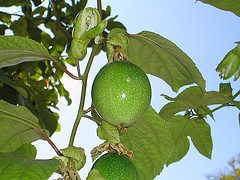 |
| Freshness facts | |
| Optimum carrying temperature | 5°C to 10°C (see text) |
| Highest freezing point | below 0°C; chilling below 5°C |
| Acceptable product temp. at loading into containers | Max. 2°C above carrying temperature |
| Optimum humidity | 90%-95% |
| Ventilation setting for containers | Closed for unripe fruit. up to 50 m³ for ripening fruit. |
| Storage life | 3 to 5 weeks |
| Climacteric / non-climacteric | Climacteric |
| Ethylene production | Very high |
| Ethylene sensitivity | High |
| Modified / controlled atmosphere | MA packaging is recommended; CA has restricted /no benefits |
| Potential benefits | See text |
| Availability | |
| Australia/New Zealand South Africa South America (Brazil) |
February - June all year round January - July |
Passion fruits
Contents
Harvesting and handling
The passion fruit is a tropical fruit that comes from different species of plants of the genus Passiflora. It is consumed for its fleshy, sweet and somewhat acid pulp. Purple passion fruit are picked according to development of skin colour whereas in the yellow variety, the fruits are gathered from the ground. The hard rind or 'shell' may become wrinkled but this does not indicate deterioration in internal quality. Inside are numerous seeds surrounded by yellowish aromatic juicy pulp. The seeds are small enough to be eaten along with the pulp; there is also an important industry in passion fruit juice.
Fruit are harvested when they are >75% turning yellow or purple. Purple passion fruit at the light-purple stage (partly green) are more suitable for long distance transport. Normally the respiratory climacteric occurs still on the plant. Fruit harvested earlier have an unripe flavour.
Size, shape, skin colour, acidity and SSC are the major criteria used to evaluate quality. Fruit should be blemish free. SSC is 10% to 18% in yellow and 10% to 20% in purple passion fruit, with the yellow type having a more acidic flavour.
Cooling and storage
Yellow passion fruit should be stored at 7°C to 10°C with 90% to 95% relative humidity. They will have a potential storage-life of 3-5 weeks. Purple passion fruit are chilling tolerant and can be stored at 5°C to 7°C for 3 to 5 weeks.
Chilling injury occurs at 5°C or lower. Symptoms of chilling injury on yellow passion fruit are skin discoloration, pitting, water soaked areas, uneven ripening and increased decay. Discoloration can penetrate the skin into the exocarp. Shrivel, pulp fermentation and fungal attack are the major postharvest problems. Shrivel is due to moisture loss without initially significantly affecting pulp quality.
Passion fruits are the highest ethylene producers among all fruits
Controlled atmosphere
Modified atmospheres (MA) have been tested on yellow passion fruit, and a fungicide treatment first before storage is desirable. Fruit held at 6°C to 10°C for 3 to 4 weeks had less shrivel. Film-bagging and various coatings reduce water loss in yellow and purple passion fruit. MA bags are customary used for purple passion fruit, what had proved beneficial effects due to reduced water loss.
Storage disorders
Bacterial spot, Brown spot, Chilling injury, Cladosporium rot, Septoria spot.