



Difference between revisions of "Methylene chloride (MEC)"
(Created page with "{{Infobox_Miscellaneous | image = Methylenechloride.jpg | origin = | stowage factor = | humidity...") |
|||
| Line 1: | Line 1: | ||
{{Infobox_Miscellaneous | {{Infobox_Miscellaneous | ||
| image = Methylenechloride.jpg | | image = Methylenechloride.jpg | ||
| − | | origin = | + | | origin = - |
| − | | stowage factor = | + | | stowage factor = - |
| − | | humidity and moisture = | + | | humidity and moisture = - |
| − | | ventilation = | + | | ventilation = - |
| − | | risk factors = | + | | risk factors = See text |
}} | }} | ||
| + | Dichloromethane (DCM or methylene chloride) is an organic compound with the formula CH<sub>2</sub>Cl<sub>2</sub>. This colourless, volatile liquid with a moderately sweet aroma is widely used as a solvent. Although it is not miscible with water, it is miscible with many organic solvents.<br><br> | ||
| + | Dichloromethane is produced by treating either methyl chloride or methane with chlorine gas at 400–500°C. At these temperatures, both methane and methyl chloride undergo a series of reactions producing progressively more chlorinated products. The output of these processes is a mixture of methyl chloride, dichloromethane, [[chloroform]], and carbon tetrachloride. These compounds are separated by distillation.<br><br> | ||
| + | DCM's volatility and ability to dissolve a wide range of organic compounds makes it a useful solvent for many chemical processes. Concerns about its health effects have led to a search for alternatives in many of these applications.<br><br> | ||
| + | ==Application== | ||
| + | Use; paint removers, solvent degreasing, [[plastics]] processing, blowing agent in foams, solvent extraction, solvent for cellulose acetate, aerosol propellant.<br><br> | ||
| + | ==Shipment / Storage== | ||
| + | Store in a tightly closed container. Keep from [[contact]] with oxidizing materials. Store in a cool, dry, well-ventilated area away from incompatible substances. Store below 40°C. Keep away from active metals.<br><br> | ||
| + | Boiling point: 40°C<br> | ||
| + | Freezing/Melting point: -97° C<br> | ||
| + | Decomposition temperature: not available.<br> | ||
| + | Solubility: moderately soluble in water<br><br> | ||
| + | ==Risk factors== | ||
| + | Toxic. A carcinogen, narcotic. TLV: 100 ppm in air.<br><br> | ||
| + | For overseas carriage aspects of [[Chemicals]], the readers are recommended to acquire or have access to a good chemical dictionary, and a copy of the International Maritime Dangerous Goods (IMDG) Code, issued by the International Maritime Organisation. Also consult the applicable MSDS sheet.<br><br> | ||
| + | |||
| + | [[Category: Products]][[Category: Oil and chemicals]] | ||
Revision as of 12:50, 9 August 2013
| Infobox on Methylene chloride (MEC) | |
|---|---|
| Example of Methylene chloride (MEC) | 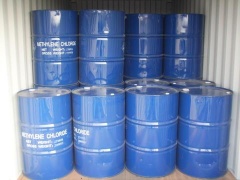 |
| Facts | |
| Origin | - |
| Stowage factor (in m3/t) | - |
| Humidity / moisture | - |
| Ventilation | - |
| Risk factors | See text |
Methylene chloride (MEC)
Dichloromethane (DCM or methylene chloride) is an organic compound with the formula CH2Cl2. This colourless, volatile liquid with a moderately sweet aroma is widely used as a solvent. Although it is not miscible with water, it is miscible with many organic solvents.
Dichloromethane is produced by treating either methyl chloride or methane with chlorine gas at 400–500°C. At these temperatures, both methane and methyl chloride undergo a series of reactions producing progressively more chlorinated products. The output of these processes is a mixture of methyl chloride, dichloromethane, chloroform, and carbon tetrachloride. These compounds are separated by distillation.
DCM's volatility and ability to dissolve a wide range of organic compounds makes it a useful solvent for many chemical processes. Concerns about its health effects have led to a search for alternatives in many of these applications.
Application
Use; paint removers, solvent degreasing, plastics processing, blowing agent in foams, solvent extraction, solvent for cellulose acetate, aerosol propellant.
Shipment / Storage
Store in a tightly closed container. Keep from contact with oxidizing materials. Store in a cool, dry, well-ventilated area away from incompatible substances. Store below 40°C. Keep away from active metals.
Boiling point: 40°C
Freezing/Melting point: -97° C
Decomposition temperature: not available.
Solubility: moderately soluble in water
Risk factors
Toxic. A carcinogen, narcotic. TLV: 100 ppm in air.
For overseas carriage aspects of Chemicals, the readers are recommended to acquire or have access to a good chemical dictionary, and a copy of the International Maritime Dangerous Goods (IMDG) Code, issued by the International Maritime Organisation. Also consult the applicable MSDS sheet.