



Difference between revisions of "Physalis"
| Line 17: | Line 17: | ||
==Harvesting and handling== | ==Harvesting and handling== | ||
The Physalis (or 'Cape Gooseberry') is a small orange [[fruit]] similar in size and shape to a cherry tomato. The berry is enclosed in a bladder-like husk, which becomes papery on maturity. Flavour is a pleasant, unique tomato /pineapple like blend. The husk is bitter and inedible. | The Physalis (or 'Cape Gooseberry') is a small orange [[fruit]] similar in size and shape to a cherry tomato. The berry is enclosed in a bladder-like husk, which becomes papery on maturity. Flavour is a pleasant, unique tomato /pineapple like blend. The husk is bitter and inedible. | ||
| − | + | <br><br> | |
| − | The uses are similar to common tomato. The fruit can be eaten raw, used in salads, desserts, as a flavouring and in jellies. | + | The uses are similar to common tomato. The fruit can be eaten raw, used in salads, desserts, as a flavouring and in jellies.<br><br> |
| − | |||
==Cooling and storage== | ==Cooling and storage== | ||
Physalis can be stored under a wide range of conditions. At ambient temperatures, the husks will dry, but the fruit will remain in good condition for about 1 week. The freshness of fruit and husk can be extended by storage at 5°C to 10°C with 70% relative humidity. | Physalis can be stored under a wide range of conditions. At ambient temperatures, the husks will dry, but the fruit will remain in good condition for about 1 week. The freshness of fruit and husk can be extended by storage at 5°C to 10°C with 70% relative humidity. | ||
| − | + | <br><br> | |
| − | Physalis can be stored for approx. 1 month at 9°C without developing chilling injury symptoms. Fruit begin to show symptoms (surface pitting and decay) after 3 weeks at 5°C; symptoms become more pronounced at 2,5°C. | + | Physalis can be stored for approx. 1 month at 9°C without developing chilling injury symptoms. Fruit begin to show symptoms (surface pitting and decay) after 3 weeks at 5°C; symptoms become more pronounced at 2,5°C.<br><br> |
| − | |||
==Mixed loads== | ==Mixed loads== | ||
| − | Immature physalis produce low amounts of ethylene, while more mature fruit produce greater amounts; fruit showing colour changes due to ripening. | + | Immature physalis produce low amounts of ethylene, while more mature fruit produce greater amounts; fruit showing colour changes due to ripening.<br><br> |
| − | |||
==Cautions== | ==Cautions== | ||
| − | Superficial moulds occur on the husk during storage under high relative humidity. | + | Superficial moulds occur on the husk during storage under high relative humidity. <br><br> |
| − | |||
==Storage disorders== | ==Storage disorders== | ||
Alternaria rot (Black mould), Chilling injury. | Alternaria rot (Black mould), Chilling injury. | ||
Revision as of 21:20, 27 March 2012
| Infobox on Physalis | |
|---|---|
| Example of Physalis | 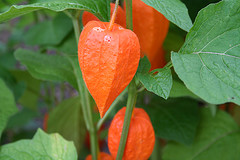 |
| Freshness facts | |
| Optimum carrying temperature | 9°C to 10°C |
| Highest freezing point | - |
| Acceptable product temp. at loading into containers | Max. 2°C above carrying temperature |
| Optimum humidity | 70%-75% |
| Ventilation setting for containers | 10 m³/hr |
| Storage life | Approx. 1 month |
| Climacteric / non-climacteric | - |
| Ethylene production | Low (see text) |
| Ethylene sensitivity | Low |
| Modified / controlled atmosphere | No information is available |
| Potential benefits | - |
| Availability | |
| South Africa Colombia |
September - January On demand |
Physalis
Contents
Harvesting and handling
The Physalis (or 'Cape Gooseberry') is a small orange fruit similar in size and shape to a cherry tomato. The berry is enclosed in a bladder-like husk, which becomes papery on maturity. Flavour is a pleasant, unique tomato /pineapple like blend. The husk is bitter and inedible.
The uses are similar to common tomato. The fruit can be eaten raw, used in salads, desserts, as a flavouring and in jellies.
Cooling and storage
Physalis can be stored under a wide range of conditions. At ambient temperatures, the husks will dry, but the fruit will remain in good condition for about 1 week. The freshness of fruit and husk can be extended by storage at 5°C to 10°C with 70% relative humidity.
Physalis can be stored for approx. 1 month at 9°C without developing chilling injury symptoms. Fruit begin to show symptoms (surface pitting and decay) after 3 weeks at 5°C; symptoms become more pronounced at 2,5°C.
Mixed loads
Immature physalis produce low amounts of ethylene, while more mature fruit produce greater amounts; fruit showing colour changes due to ripening.
Cautions
Superficial moulds occur on the husk during storage under high relative humidity.
Storage disorders
Alternaria rot (Black mould), Chilling injury.