



Difference between revisions of "Mangoes"
m (NvD corrections) |
|||
| (5 intermediate revisions by 2 users not shown) | |||
| Line 1: | Line 1: | ||
{{Infobox_Fruit | {{Infobox_Fruit | ||
| image = mangoes.jpg | | image = mangoes.jpg | ||
| − | | carrying temperature = | + | | carrying temperature = 8°C to 10°C |
| − | | highest freezing point = -1°C | + | | highest freezing point = -1°C, chilling below 8°C |
| acceptable product temp = Max. 2°C above carrying temperature | | acceptable product temp = Max. 2°C above carrying temperature | ||
| Optimum humidity = 85%-90% | | Optimum humidity = 85%-90% | ||
| Ventilation setting for containers = 25 m³/hr | | Ventilation setting for containers = 25 m³/hr | ||
| − | | Storage life = | + | | Storage life = 3-4 weeks |
| Climateric / non-climateric = Climacteric | | Climateric / non-climateric = Climacteric | ||
| Ethylene production = Moderate | | Ethylene production = Moderate | ||
| Line 13: | Line 13: | ||
| Potential benefits = Low O<SUB>2</SUB> can delay ripening <br> Elevated CO<SUB>2</SUB> maintains firmness | | Potential benefits = Low O<SUB>2</SUB> can delay ripening <br> Elevated CO<SUB>2</SUB> maintains firmness | ||
| − | | Locations = Australia <br> South Africa <br> South America <br> Central America | + | | Locations = Australia <br> South Africa <br> South America <br> Central America <br> West Africa <br> |
| − | | Months = November - January <br> | + | | Months = November - January <br> February - April <br> September - May <br> January - October <br> March - July <br> |
}} | }} | ||
==Harvesting and handling== | ==Harvesting and handling== | ||
| − | + | Mangoes have an ovoid shape, non-edible rind and variable colour, from of pale yellow to dark red. The pulp is sticky and its coloration ranges from yellow to orange. The taste of ripe mangoes is sweet, and quite acid when still green. It is a juicy and fibrous fruit, with a stone inside. The mango is cultivated throughout the tropics and warmer sub-tropics. There are numerous varieties, with the varieties Tommy Atkins, Kent, Keitt, and Haden being the most common. Fruit skin is yellow or green with a golden to red blush. Weight can vary from 200 g to 1 kg and can be round, oval or kidney shaped. Some varieties have a turpentine like smell and taste.<br> | |
| − | + | Skin colouration, size, shape for variety, appearance, freedom from defects and decay, absence of fibre in the flesh and turpentine-like flavours are the most common quality parameters. Wilted, greyish discolouration and pitting are undesirable. Some fruit varieties (Haden) have pinhead-size black spotting that is not regarded as a defect.<br> | |
| − | Skin colouration, size, shape for variety, appearance, freedom from defects and decay, absence of fibre in the flesh and turpentine-like flavours are the most common quality parameters. Wilted, greyish discolouration and pitting are undesirable. Some fruit varieties (Haden) have pinhead-size black spotting that is not regarded as a defect.<br> | + | |
| + | Mangoes are highly pressure- and impact-sensitive and appropriate care must therefore be taken during cargo handling. | ||
==Cooling and storage== | ==Cooling and storage== | ||
| − | + | Mangoes show a climacteric pattern of respiration and, during ripening, the flesh becomes soft and juicy with a rich flavour and aromatic fragrance. The onset of ripening is accompanied by a five-fold increase in heat production as well as the production of ethylene. In view of this substantial increase in heat production which accompanies the onset of ripening (before any visual change is apparent), it is essential that fruit for overseas shipment be cooled as soon as possible, preferably within 24 hours of harvest. If more than a small proportion of mangoes has entered the climacteric stage by the time of loading into refrigerated space, there is a risk that heat production by the mangoes may impose too great a burden on the cooling cycles. If this happens, more and more fruit is triggered into ripening in an atmosphere depleted of oxygen and rich in carbon dioxide and ethylene; the temperature rises further and ripening proceeds in abnormal fashion. Inadequate ventilation may result in fermentation and rotting of the cargo as a result of increased CO<SUB>2</SUB> levels and inadequate supply of atmospheric oxygen. | |
| − | |||
| − | Mangoes show a climacteric pattern of respiration and, during ripening, the flesh becomes soft and juicy with a rich flavour and aromatic fragrance. The onset of ripening is accompanied by a five-fold increase in heat production. In view of this substantial increase in heat production which accompanies the onset of ripening (before any visual change is apparent), it is essential that fruit for overseas shipment be cooled as soon as possible, preferably within 24 hours of harvest. If more than a small proportion of mangoes has entered the climacteric stage by the time of loading into refrigerated space, there is a risk that heat production by the mangoes may impose too great a burden on the cooling cycles. If this happens, more and more fruit is triggered into ripening in an atmosphere depleted of oxygen and rich in carbon dioxide and ethylene; the temperature rises further and ripening proceeds in abnormal fashion. | ||
<br><br> | <br><br> | ||
| − | Storage at 8°C to 10°C with 85% to 90% RH, should give a shelf-life of 3-4 weeks for mature green fruit, depending upon variety. Chilling susceptibility varies with cultivar; Haden and Keitt are particularly susceptible. Most cultivars show injury below 8°C, especially if fruit have just reached maturity. Tolerance to chilling injury increases during ripening. Ripe fruit can be stored at 7°C to 8°C. | + | Storage at 8°C to 10°C with 85% to 90% RH, should give a shelf-life of 3 - 4 weeks for mature green fruit, depending upon variety. Chilling susceptibility varies with cultivar; Haden and Keitt are particularly susceptible. Most cultivars show injury below 8°C, especially if fruit have just reached maturity. Tolerance to chilling injury increases during ripening. Ripe fruit can be stored at 7°C to 8°C. |
<br><br> | <br><br> | ||
Symptoms of chilling injury include uneven ripening, poor colour and flavour, surface pitting, greyish scald-like skin discoloration, increased susceptibility to decay, and, in severe cases, flesh browning. Chilling injury incidence and severity depend on cultivar, ripeness stage (riper mangoes are less susceptible) and temperature and duration of exposure. | Symptoms of chilling injury include uneven ripening, poor colour and flavour, surface pitting, greyish scald-like skin discoloration, increased susceptibility to decay, and, in severe cases, flesh browning. Chilling injury incidence and severity depend on cultivar, ripeness stage (riper mangoes are less susceptible) and temperature and duration of exposure. | ||
| Line 38: | Line 37: | ||
==Storage disorders== | ==Storage disorders== | ||
| − | Alternaria black spot, Anthracnose, Bacterial black spot, Bacterial rot, Black mould rot, Chilling injury, Internal breakdown, Powdery mildew, Soft nose, Stem end breakdown, Stem end rot. | + | Alternaria black spot, Anthracnose, Bacterial black spot, Bacterial rot, Black mould rot, Chilling injury, Internal breakdown, Jelly seed disorder, Powdery mildew, Soft nose, Stem end breakdown, Stem end rot, Suffocation. |
[[Category:Perishables]] | [[Category:Perishables]] | ||
[[Category:Products]] | [[Category:Products]] | ||
Latest revision as of 14:35, 15 September 2025
| Infobox on Mangoes | |
|---|---|
| Example of Mangoes | 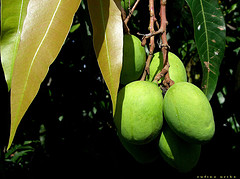 |
| Freshness facts | |
| Optimum carrying temperature | 8°C to 10°C |
| Highest freezing point | -1°C, chilling below 8°C |
| Acceptable product temp. at loading into containers | Max. 2°C above carrying temperature |
| Optimum humidity | 85%-90% |
| Ventilation setting for containers | 25 m³/hr |
| Storage life | 3-4 weeks |
| Climacteric / non-climacteric | Climacteric |
| Ethylene production | Moderate |
| Ethylene sensitivity | High |
| Modified / controlled atmosphere | 5%-8% CO2; 3%-7% O2 |
| Potential benefits | Low O2 can delay ripening Elevated CO2 maintains firmness |
| Availability | |
| Australia South Africa South America Central America West Africa |
November - January February - April September - May January - October March - July |
Mangoes
Contents
Harvesting and handling
Mangoes have an ovoid shape, non-edible rind and variable colour, from of pale yellow to dark red. The pulp is sticky and its coloration ranges from yellow to orange. The taste of ripe mangoes is sweet, and quite acid when still green. It is a juicy and fibrous fruit, with a stone inside. The mango is cultivated throughout the tropics and warmer sub-tropics. There are numerous varieties, with the varieties Tommy Atkins, Kent, Keitt, and Haden being the most common. Fruit skin is yellow or green with a golden to red blush. Weight can vary from 200 g to 1 kg and can be round, oval or kidney shaped. Some varieties have a turpentine like smell and taste.
Skin colouration, size, shape for variety, appearance, freedom from defects and decay, absence of fibre in the flesh and turpentine-like flavours are the most common quality parameters. Wilted, greyish discolouration and pitting are undesirable. Some fruit varieties (Haden) have pinhead-size black spotting that is not regarded as a defect.
Mangoes are highly pressure- and impact-sensitive and appropriate care must therefore be taken during cargo handling.
Cooling and storage
Mangoes show a climacteric pattern of respiration and, during ripening, the flesh becomes soft and juicy with a rich flavour and aromatic fragrance. The onset of ripening is accompanied by a five-fold increase in heat production as well as the production of ethylene. In view of this substantial increase in heat production which accompanies the onset of ripening (before any visual change is apparent), it is essential that fruit for overseas shipment be cooled as soon as possible, preferably within 24 hours of harvest. If more than a small proportion of mangoes has entered the climacteric stage by the time of loading into refrigerated space, there is a risk that heat production by the mangoes may impose too great a burden on the cooling cycles. If this happens, more and more fruit is triggered into ripening in an atmosphere depleted of oxygen and rich in carbon dioxide and ethylene; the temperature rises further and ripening proceeds in abnormal fashion. Inadequate ventilation may result in fermentation and rotting of the cargo as a result of increased CO2 levels and inadequate supply of atmospheric oxygen.
Storage at 8°C to 10°C with 85% to 90% RH, should give a shelf-life of 3 - 4 weeks for mature green fruit, depending upon variety. Chilling susceptibility varies with cultivar; Haden and Keitt are particularly susceptible. Most cultivars show injury below 8°C, especially if fruit have just reached maturity. Tolerance to chilling injury increases during ripening. Ripe fruit can be stored at 7°C to 8°C.
Symptoms of chilling injury include uneven ripening, poor colour and flavour, surface pitting, greyish scald-like skin discoloration, increased susceptibility to decay, and, in severe cases, flesh browning. Chilling injury incidence and severity depend on cultivar, ripeness stage (riper mangoes are less susceptible) and temperature and duration of exposure.
Mixed loads
Do not ship with ethylene-producing commodities
Cautions
O2 below 2% for longer than two weeks can cause off-flavours and skin discoloration. CO2 above 10% can cause softening, off-flavours and greyish flesh colour.
Storage disorders
Alternaria black spot, Anthracnose, Bacterial black spot, Bacterial rot, Black mould rot, Chilling injury, Internal breakdown, Jelly seed disorder, Powdery mildew, Soft nose, Stem end breakdown, Stem end rot, Suffocation.