



Difference between revisions of "Asparagus"
m (NvD corrections) |
|||
| (13 intermediate revisions by 4 users not shown) | |||
| Line 4: | Line 4: | ||
| highest freezing point = -0,6°C | | highest freezing point = -0,6°C | ||
| acceptable product temp = Max. 2°C above carrying temperature | | acceptable product temp = Max. 2°C above carrying temperature | ||
| − | | Optimum humidity = 95% | + | | Optimum humidity = 95% - 100% |
| − | | Ventilation setting for containers = | + | | Ventilation setting for containers = 10 m³/hr |
| − | | Storage life = | + | | Storage life = 4 weeks |
| Climateric / non-climateric = Non-climacteric | | Climateric / non-climateric = Non-climacteric | ||
| Ethylene production = Very low | | Ethylene production = Very low | ||
| Ethylene sensitivity = Medium | | Ethylene sensitivity = Medium | ||
| − | | Modified / controlled atmosphere = 5%-9% CO<SUB>2</SUB> at 3°/6°C or 10%-14% at | + | | Modified / controlled atmosphere = 5%-9% CO<SUB>2</SUB> at 3°/6°C or 10%-14% CO<SUB>2</SUB> at 0-3°C |
| Potential benefits = O<SUB>2</SUB> none; CO<SUB>2</SUB> - high | | Potential benefits = O<SUB>2</SUB> none; CO<SUB>2</SUB> - high | ||
| − | | Locations = Australia | + | | Locations = Australia <br> New Zealand <br> South Africa <br> S. America <br>(Argentine/Chile)<br> C. America <br> N. America <br> N. Europe <br> Netherlands <br> |
| − | | Months = September - December <br> September - December <br> <br> August - December <br> June - February <br> February - June <br> March - June <br> April-July | + | | Months = September - December <br> September - December <br> September - December <br> September - December <br> August - December <br> June - February <br> February - June <br> March - June <br> April-July |
}} | }} | ||
==Harvesting and Handling== | ==Harvesting and Handling== | ||
| − | + | The asparagus is the stem or shoot of the asparagus plant, that is harvested unripe, before it branches and hardens. According to the handling during the culture, two types are obtained: white and green. The colour does not really depend on the variety, but on the culture method. The white asparagus are buried, so they do not have direct sunlight and do not synthesise chlorophyll, that confers the green colour on the plant. However, there are varieties which are more suitable for obtaining one type of asparagus or another. There is also a type called wild asparagus, which comes from another species of plant. The edible portion of asparagus is a rapidly growing stem (shoot) with scale leaves that arise at nodes. White asparagus is widely used in Europe and Asia; green asparagus is popular in the U.S. and is produced predominantly in California and Washington. Asparagus has a high metabolic rate after harvest and is among the most perishable crops.<br><br> | |
| − | + | High quality asparagus spears are firm with tightly closed and compact tips. Stems are straight, tender and glossy in appearance. Spears with green butts are preferred over the spears with white butts as the latter are associated with increased toughness. However, a small amount of white tissue at the butt will delay decay development under typical commercial distribution conditions.<br><br> | |
| − | + | Asparagus spears are harvested as they emerge through the soil from the underground crowns. Typically, spears are cut when they reach 20 - 25 cm., with spear tips still tightly closed. Tender, immature asparagus may be harvested for special market. Stalk diameter is not a good indicator of proper maturity and associated tenderness. | |
| − | + | <br><br> | |
| − | + | Harvested spears are prepared for market by grading, sizing and bunching. Grades are based on freshness, length and diameter of the stalks, colour of spears, tightness of the spear tips, and the extent of bruising. Spears of larger diameter are considered to be superior in quality with less fibre. After trimming the butt-end, the bunches are packed upright in such a way as to minimize geotropic bending (curving away from gravity) in transit. The bunches with asparagus are packed in closed poly sachets, inside perforated poly boxes. The asparagus should remain moist witha humidity inside the sachets of 95% to 100%, but excessive free water at elevated storage or shipping temperatures may lead to increased decay. Headspace is provided in the packaging to allow for spear elongation without tip curvature or breakage.<br><br> | |
| − | + | At present, asparagus are cultivated all over the world.China produces approximately 80% of the world-wide production, but for the internal market. The main export countries are Mexico and Peru. | |
| − | |||
| − | |||
| − | |||
| − | |||
| − | |||
| − | |||
| − | |||
| − | |||
| − | |||
| − | |||
| − | |||
| − | |||
| − | |||
| − | |||
| − | |||
| − | Asparagus | ||
| − | |||
| − | Harvested spears are prepared for market by grading, sizing and bunching. Grades are based on freshness, length and diameter of the stalks, colour of spears, tightness of the spear tips, and the extent of bruising. Spears of larger diameter are considered to be superior in quality with less fibre. After trimming the butt-end, the bunches are packed upright in such a way as to minimize geotropic bending (curving away from gravity) in transit. The | ||
==Cooling and Storage== | ==Cooling and Storage== | ||
| − | Asparagus is highly perishable and must be cooled immediately to 0°/2°C. A 4 hour delay in cooling resulted in an average 40% increase in shear force due to tissue toughening. Asparagus is typically partially cooled during the washing selection and packing operation, and then hydro-cooled to near 0°C after packing. | + | Asparagus is highly perishable and must be cooled immediately to 0°/2°C. A 4 hour delay in cooling resulted in an average 40% increase in shear force due to tissue toughening. Asparagus is typically partially cooled during the washing selection and packing operation, and then hydro-cooled to near 0°C after packing. Maintaining a low storage temperature is critical to delay senescence, tissue toughening and flavour loss. High RH is essential to prevent desiccation and to maintain freshness. |
| − | + | <br><br> | |
| − | Maintaining a low storage temperature is critical to delay senescence, tissue toughening and flavour loss. High RH is essential to prevent desiccation and to maintain freshness. | + | Asparagus continues to grow and elongate after harvest if not cooled immediately and stored at low temperatures (<5°C). Contacting water at the butt will also promote spear growth and elongation. Tip bending occurs as the result of upward growth of the tips when the spears are horizontal. Held in an upright position, tip bending may still occur if the tips reach the top of the package and are physically deflected. Freezing injury occurs at temperatures below -0,5°C, and results in water-soaked appearance and tissue softening. |
| − | + | <br><br> | |
| − | Asparagus continues to grow and elongate after harvest if not cooled immediately and stored at low temperatures (<5°C). Contacting water at the butt will also promote spear growth and elongation. Tip bending occurs as the result of upward growth of the tips when the spears are horizontal. Held in an upright position, tip bending may still occur if the tips reach the top of the package and are physically deflected. | + | Exposure to ethylene will accelerate the lignification (toughening) of asparagus spears. |
| − | + | <br><br> | |
| − | Freezing injury occurs at temperatures below -0,5°C, and results in water-soaked appearance and tissue softening. | ||
| − | |||
| − | |||
| − | |||
| − | |||
==Controlled atmosphere considerations== | ==Controlled atmosphere considerations== | ||
| − | Elevated CO<SUB>2</SUB> at 5-10% (typically 7%) in air is beneficial in preventing decay and reducing the rate of toughening of the spears. The beneficial effect is most pronounced if temperatures cannot be maintained below 5°C. Short (CA) exposure to higher CO<SUB>2</SUB> concentrations (12-20%) is safe and beneficial only if temperatures can be maintained at 0° - 1°C. | + | Elevated CO<SUB>2</SUB> at 5-10% (typically 7%) in air is beneficial in preventing decay and reducing the rate of toughening of the spears. The beneficial effect is most pronounced if temperatures cannot be maintained below 5°C. Short (CA) exposure to higher CO<SUB>2</SUB> concentrations (12-20%) is safe and beneficial only if temperatures can be maintained at 0° - 1°C. Signs of CO<SUB>2</SUB> injury are small to elongated pits, generally first observed just below the tips. Severe injury results in ribbiness. The combination of intermediate O<SUB>2</SUB> (2% to 10%) may or may not provide benefit compared to air enriched with CO<SUB>2</SUB> alone. At O<SUB>2</SUB> levels below 2%, off-odours and discolouration may develop. |
| + | <br> | ||
| − | + | ==Storage disorders== | |
| − | + | Bacterial soft rot, Blue mould, Carbon dioxide injury, Chilling and/or freezing injury, Fusarium, Phytophthora, Pitting, Purpler spot, Tip rot, Watery soft rot, spear bending, spear toughening, bruising and tip breakage. | |
| − | |||
| − | |||
| − | |||
| − | |||
[[Category:Perishables]] | [[Category:Perishables]] | ||
[[Category:Products]] | [[Category:Products]] | ||
Latest revision as of 16:18, 3 September 2025
| Infobox on Asparagus | |
|---|---|
| Example of Asparagus | 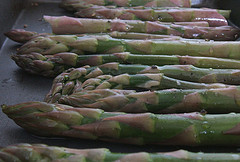 |
| Freshness facts | |
| Optimum carrying temperature | 0°C / +2°C |
| Highest freezing point | -0,6°C |
| Acceptable product temp. at loading into containers | Max. 2°C above carrying temperature |
| Optimum humidity | 95% - 100% |
| Ventilation setting for containers | 10 m³/hr |
| Storage life | 4 weeks |
| Climacteric / non-climacteric | Non-climacteric |
| Ethylene production | Very low |
| Ethylene sensitivity | Medium |
| Modified / controlled atmosphere | 5%-9% CO2 at 3°/6°C or 10%-14% CO2 at 0-3°C |
| Potential benefits | O2 none; CO2 - high |
| Availability | |
| Australia New Zealand South Africa S. America (Argentine/Chile) C. America N. America N. Europe Netherlands |
September - December September - December September - December September - December August - December June - February February - June March - June April-July |
Asparagus
Contents
Harvesting and Handling
The asparagus is the stem or shoot of the asparagus plant, that is harvested unripe, before it branches and hardens. According to the handling during the culture, two types are obtained: white and green. The colour does not really depend on the variety, but on the culture method. The white asparagus are buried, so they do not have direct sunlight and do not synthesise chlorophyll, that confers the green colour on the plant. However, there are varieties which are more suitable for obtaining one type of asparagus or another. There is also a type called wild asparagus, which comes from another species of plant. The edible portion of asparagus is a rapidly growing stem (shoot) with scale leaves that arise at nodes. White asparagus is widely used in Europe and Asia; green asparagus is popular in the U.S. and is produced predominantly in California and Washington. Asparagus has a high metabolic rate after harvest and is among the most perishable crops.
High quality asparagus spears are firm with tightly closed and compact tips. Stems are straight, tender and glossy in appearance. Spears with green butts are preferred over the spears with white butts as the latter are associated with increased toughness. However, a small amount of white tissue at the butt will delay decay development under typical commercial distribution conditions.
Asparagus spears are harvested as they emerge through the soil from the underground crowns. Typically, spears are cut when they reach 20 - 25 cm., with spear tips still tightly closed. Tender, immature asparagus may be harvested for special market. Stalk diameter is not a good indicator of proper maturity and associated tenderness.
Harvested spears are prepared for market by grading, sizing and bunching. Grades are based on freshness, length and diameter of the stalks, colour of spears, tightness of the spear tips, and the extent of bruising. Spears of larger diameter are considered to be superior in quality with less fibre. After trimming the butt-end, the bunches are packed upright in such a way as to minimize geotropic bending (curving away from gravity) in transit. The bunches with asparagus are packed in closed poly sachets, inside perforated poly boxes. The asparagus should remain moist witha humidity inside the sachets of 95% to 100%, but excessive free water at elevated storage or shipping temperatures may lead to increased decay. Headspace is provided in the packaging to allow for spear elongation without tip curvature or breakage.
At present, asparagus are cultivated all over the world.China produces approximately 80% of the world-wide production, but for the internal market. The main export countries are Mexico and Peru.
Cooling and Storage
Asparagus is highly perishable and must be cooled immediately to 0°/2°C. A 4 hour delay in cooling resulted in an average 40% increase in shear force due to tissue toughening. Asparagus is typically partially cooled during the washing selection and packing operation, and then hydro-cooled to near 0°C after packing. Maintaining a low storage temperature is critical to delay senescence, tissue toughening and flavour loss. High RH is essential to prevent desiccation and to maintain freshness.
Asparagus continues to grow and elongate after harvest if not cooled immediately and stored at low temperatures (<5°C). Contacting water at the butt will also promote spear growth and elongation. Tip bending occurs as the result of upward growth of the tips when the spears are horizontal. Held in an upright position, tip bending may still occur if the tips reach the top of the package and are physically deflected. Freezing injury occurs at temperatures below -0,5°C, and results in water-soaked appearance and tissue softening.
Exposure to ethylene will accelerate the lignification (toughening) of asparagus spears.
Controlled atmosphere considerations
Elevated CO2 at 5-10% (typically 7%) in air is beneficial in preventing decay and reducing the rate of toughening of the spears. The beneficial effect is most pronounced if temperatures cannot be maintained below 5°C. Short (CA) exposure to higher CO2 concentrations (12-20%) is safe and beneficial only if temperatures can be maintained at 0° - 1°C. Signs of CO2 injury are small to elongated pits, generally first observed just below the tips. Severe injury results in ribbiness. The combination of intermediate O2 (2% to 10%) may or may not provide benefit compared to air enriched with CO2 alone. At O2 levels below 2%, off-odours and discolouration may develop.
Storage disorders
Bacterial soft rot, Blue mould, Carbon dioxide injury, Chilling and/or freezing injury, Fusarium, Phytophthora, Pitting, Purpler spot, Tip rot, Watery soft rot, spear bending, spear toughening, bruising and tip breakage.