



Difference between revisions of "Lemons"
m (NvD corrections) |
|||
| (9 intermediate revisions by 3 users not shown) | |||
| Line 1: | Line 1: | ||
{{Infobox_Fruit | {{Infobox_Fruit | ||
| − | | image = | + | | image = lemons.jpg |
| − | | carrying temperature = | + | | carrying temperature = 10°C to 11°C (yellow lemons)<br> 12°C to 14°C (green lemons) |
| − | | highest freezing point = | + | | highest freezing point = -1,4°C; chilling injury occurs below 5°C or during long term storage already below 10°C |
| − | | acceptable product temp = | + | | acceptable product temp = Max. 5°C above carrying temperature |
| − | | Optimum humidity = | + | | Optimum humidity = 90% |
| − | | Ventilation setting for containers = | + | | Ventilation setting for containers = 25 m³/hr |
| − | | Storage life = | + | | Storage life = 2-3 months |
| − | | Climateric / non-climateric = | + | | Climateric / non-climateric = Non-climacteric |
| − | | Ethylene production = | + | | Ethylene production = Very Low |
| − | | Ethylene sensitivity = | + | | Ethylene sensitivity = Moderate |
| − | | Modified / controlled atmosphere = | + | | Modified / controlled atmosphere = 0%-10% CO<SUB>2</SUB>; 5%-10% O<SUB>2</SUB> |
| − | | Potential benefits = | + | | Potential benefits = Low O<SUB>2</SUB> delays senescence. <br> Elevated CO<SUB>2</SUB> may delay loss of green colour |
| − | | Locations = | + | | Locations = South Africa <br> South America |
| − | | Months = | + | | Months = April - December <br> June - September |
}} | }} | ||
| + | == Harvesting and handling == | ||
| + | The lemon is rounded and slightly elongated, it belongs to the family of citrus fruit and therefore it shares many of the characteristics of other species of citruses. The pulp is pale yellow, juicy and with an acid flavour; it is divided in gores. The skin is yellow and specially bright when it is ripen. <br> <br> | ||
| + | The primary quality characteristics of lemons are intensity and uniformity of yellow colour, size, shape, smoothness, firmness, freedom from decay and defects including freezing damage, drying, mechanical damage, rind stains, red blotch, shrivelling and discolouration. Lemons should have smooth thin skins and be firm. Ripe lemons should have a pleasant citrus fragrance. | ||
| + | == Cooling and storage == | ||
| + | Yellow lemons harvested when dark-green have a much longer postharvest life than those picked yellow, which must be marketed more rapidly due to their shorter shelf-life. Lemons can be stored between 10°C to 14°C depending on the maturity-ripeness stage at harvest, season of harvest, storage time and production area. They can be stored for up to 6 months under the right conditions. The cargo should be pre-cooled prior to loading.<br> | ||
| + | |||
| + | Temperatures higher than 15°C favour the growth of decay organisms and shorten the storage life. Lemons that are of proper size and dark-green colour when picked have the longest storage life. Tree-ripened, yellow fruit do not keep so well in storage. Lemons from different production areas have different keeping qualities. Storage at terminal markets often involves considerable risk, as most of the storage life may have been used up before shipment and the fruit may be especially subject to decay. Therefore, knowledge of the previous history of the lemons is desirable. <br> | ||
| + | |||
| + | Because lemons are chilling sensitive, they should not be stored for prolonged periods below 10°C, although 3 to 4 weeks storage at 3° to 5 °C, which is typical for some receivers, is usually tolerated without harm. Removal of ethylene from storage rooms can reduce senescence and incidence of fungal decay. It is generally recognized that proper storage of lemons improves quality, ie., juice content, flavor and colour.<br> | ||
| + | |||
| + | Lemons should be stored away from produce with a strong odor. Also, decay can occur from skin cuts or scratches caused by rough handling. Lemons should be handle with care. Any affected product should be removed immediately to prevent mould from spreading.<br> | ||
| + | |||
| + | Levels of respiratory gases which promote ripening, such as ethylene as well as carbon dioxide, should be kept as low as possible. If ventilation is inadequate, storage damage, such as a bitter flavour and peel scab, may occur. The supply of fresh air must thus be constant in order to dissipate these gases. | ||
| + | <br> | ||
| + | |||
| + | Fungicides are diphenyl, orthophenylphenol (OPP) and thiabendazole (TBZ). Diphenyl can be recognized from its naphthalene-like odour. The fungicides primarily prevent blue and green moulds, but they do impair flavour and indication of their use is mandatory. | ||
| + | Seawater, rain and condensation water promote green and blue mould growth. | ||
| + | |||
| + | == Mixed loads == | ||
| + | Lemons should not be mixed with ethylene-producing commodities. Lemons absorb odours from strongly scented vegetables and so should not be mixed with such commodities. | ||
| + | |||
| + | == Cautions == | ||
| + | O<SUB>2</SUB> below 5% can cause off-flavours. CO<SUB>2</SUB> greater than 10% may cause increased susceptibility to decay as well as decreased acidity. | ||
| + | |||
| + | == Storage disorders == | ||
| + | Alternaria rot, Anthracnose, Aspergillus rot, Black mould rot, Black pit, Black spot, Blue mould, Brown rot, Canker, Chilling injury, Cottonry rot, Degreening, Fusarium, Green mould rot, Grey mould rot, Insect damage, Melanose, Rind discolouration, Scab, Scald, Senescent breakdown, Sooty blotch, Sooty mould, Sour rot, Stem end rots. | ||
| − | |||
[[Category:Perishables]] | [[Category:Perishables]] | ||
[[Category:Products]] | [[Category:Products]] | ||
Latest revision as of 16:20, 10 September 2025
| Infobox on Lemons | |
|---|---|
| Example of Lemons | 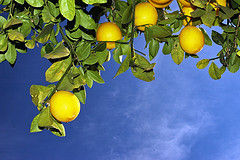 |
| Freshness facts | |
| Optimum carrying temperature | 10°C to 11°C (yellow lemons) 12°C to 14°C (green lemons) |
| Highest freezing point | -1,4°C; chilling injury occurs below 5°C or during long term storage already below 10°C |
| Acceptable product temp. at loading into containers | Max. 5°C above carrying temperature |
| Optimum humidity | 90% |
| Ventilation setting for containers | 25 m³/hr |
| Storage life | 2-3 months |
| Climacteric / non-climacteric | Non-climacteric |
| Ethylene production | Very Low |
| Ethylene sensitivity | Moderate |
| Modified / controlled atmosphere | 0%-10% CO2; 5%-10% O2 |
| Potential benefits | Low O2 delays senescence. Elevated CO2 may delay loss of green colour |
| Availability | |
| South Africa South America |
April - December June - September |
Lemons
Contents
Harvesting and handling
The lemon is rounded and slightly elongated, it belongs to the family of citrus fruit and therefore it shares many of the characteristics of other species of citruses. The pulp is pale yellow, juicy and with an acid flavour; it is divided in gores. The skin is yellow and specially bright when it is ripen.
The primary quality characteristics of lemons are intensity and uniformity of yellow colour, size, shape, smoothness, firmness, freedom from decay and defects including freezing damage, drying, mechanical damage, rind stains, red blotch, shrivelling and discolouration. Lemons should have smooth thin skins and be firm. Ripe lemons should have a pleasant citrus fragrance.
Cooling and storage
Yellow lemons harvested when dark-green have a much longer postharvest life than those picked yellow, which must be marketed more rapidly due to their shorter shelf-life. Lemons can be stored between 10°C to 14°C depending on the maturity-ripeness stage at harvest, season of harvest, storage time and production area. They can be stored for up to 6 months under the right conditions. The cargo should be pre-cooled prior to loading.
Temperatures higher than 15°C favour the growth of decay organisms and shorten the storage life. Lemons that are of proper size and dark-green colour when picked have the longest storage life. Tree-ripened, yellow fruit do not keep so well in storage. Lemons from different production areas have different keeping qualities. Storage at terminal markets often involves considerable risk, as most of the storage life may have been used up before shipment and the fruit may be especially subject to decay. Therefore, knowledge of the previous history of the lemons is desirable.
Because lemons are chilling sensitive, they should not be stored for prolonged periods below 10°C, although 3 to 4 weeks storage at 3° to 5 °C, which is typical for some receivers, is usually tolerated without harm. Removal of ethylene from storage rooms can reduce senescence and incidence of fungal decay. It is generally recognized that proper storage of lemons improves quality, ie., juice content, flavor and colour.
Lemons should be stored away from produce with a strong odor. Also, decay can occur from skin cuts or scratches caused by rough handling. Lemons should be handle with care. Any affected product should be removed immediately to prevent mould from spreading.
Levels of respiratory gases which promote ripening, such as ethylene as well as carbon dioxide, should be kept as low as possible. If ventilation is inadequate, storage damage, such as a bitter flavour and peel scab, may occur. The supply of fresh air must thus be constant in order to dissipate these gases.
Fungicides are diphenyl, orthophenylphenol (OPP) and thiabendazole (TBZ). Diphenyl can be recognized from its naphthalene-like odour. The fungicides primarily prevent blue and green moulds, but they do impair flavour and indication of their use is mandatory. Seawater, rain and condensation water promote green and blue mould growth.
Mixed loads
Lemons should not be mixed with ethylene-producing commodities. Lemons absorb odours from strongly scented vegetables and so should not be mixed with such commodities.
Cautions
O2 below 5% can cause off-flavours. CO2 greater than 10% may cause increased susceptibility to decay as well as decreased acidity.
Storage disorders
Alternaria rot, Anthracnose, Aspergillus rot, Black mould rot, Black pit, Black spot, Blue mould, Brown rot, Canker, Chilling injury, Cottonry rot, Degreening, Fusarium, Green mould rot, Grey mould rot, Insect damage, Melanose, Rind discolouration, Scab, Scald, Senescent breakdown, Sooty blotch, Sooty mould, Sour rot, Stem end rots.