



Difference between revisions of "Pears"
m (→Cooling and Storage) |
|||
| (2 intermediate revisions by the same user not shown) | |||
| Line 2: | Line 2: | ||
| image = pears.jpg | | image = pears.jpg | ||
| carrying temperature = -1,0°C to -0,5°C | | carrying temperature = -1,0°C to -0,5°C | ||
| − | | highest freezing point = -1, | + | | highest freezing point = -1,5°C |
| acceptable product temp = Max. 2°C above carrying temperature | | acceptable product temp = Max. 2°C above carrying temperature | ||
| − | | Optimum humidity = 90 to 95% | + | | Optimum humidity = 90% to 95% |
| − | | Ventilation setting for containers = | + | | Ventilation setting for containers = 10 m³/hr |
| Storage life = 1-3 months Bartlett (William's Bon Chrétien)<br> 3 months Beurre Bosc <br> 3-4 months Comice <br> 3-6 months Packham's Triumph <br> 4-6 month d'Anjou | | Storage life = 1-3 months Bartlett (William's Bon Chrétien)<br> 3 months Beurre Bosc <br> 3-4 months Comice <br> 3-6 months Packham's Triumph <br> 4-6 month d'Anjou | ||
| Climateric / non-climateric = Climacteric | | Climateric / non-climateric = Climacteric | ||
| Line 12: | Line 12: | ||
| Modified / controlled atmosphere = 0-3% CO<SUB>2</SUB>; 1%-3% O<SUB>2</SUB> | | Modified / controlled atmosphere = 0-3% CO<SUB>2</SUB>; 1%-3% O<SUB>2</SUB> | ||
| Potential benefits = Excellent | | Potential benefits = Excellent | ||
| − | | Locations = Australia | + | | Locations = Europw <br> Australia <br> New Zealand <br> South Africa <br> South America |
| − | | Months = February - July <br> February - July <br> January - June | + | | Months = July - June (year round) <br> February - July <br> February - July <br> February - July <br> January - June |
}} | }} | ||
==Harvesting and Handling== | ==Harvesting and Handling== | ||
| − | + | The pear is a fruit that has expanded all over the world. It is consumed both fresh as cooked and is available all year round. | |
| + | A large number of varieties are cultivated, ranging in shape, size and colour. | ||
<br><br> | <br><br> | ||
| − | The fruit must be handled very carefully, since | + | Harvesting at the correct time is essential to ensure maximum storage life. Pear fruit harvested with improper maturity are more susceptible to physiological disorders and have a shorter storage-life. Immature pears are more susceptible to superficial scald, shrivelling and friction discoloration while over mature fruit tend to have higher incidence of core breakdown and CO2 injury. |
| + | <br><br> | ||
| + | One of the most satisfactory and easiest ways of determining proper harvest maturity is to measure fruit firmness. Pressure tests using a penetrometer on the pared surface gives an indication of flesh firmness. Firmness decreases with maturation. Different varieties have different firmness at maturity. The pressure can be read in kilogram force (kgf). At the pre-climacteric stage, the firmness of most pears varieties is between 9 and 10 kgf. During ripening, the firmness decreases by approx. 2-3 kgf. Pears testing at <5 kgf will have little storage life remaining and should be sold at earliest convenience. | ||
| + | <br><br> | ||
| + | The fruit must be handled very carefully, since during harvest and handling bruising can easily occur and may start to rot within just a few days. Where possible, the pears should be of uniform size and packed in pre-formed mouldings to even out pressure and prevent injury. Size grading is generally performed mechanically. Packaging in (export cartons and) polyethylene bags has beneficial effects on storage and shelf life, but retards cooling. | ||
<br><br> | <br><br> | ||
Quality characteristics and criteria of a properly ripened pear fruit are buttery and juicy texture with the distinct pear aroma and taste of each pear cultivar.<br><br> | Quality characteristics and criteria of a properly ripened pear fruit are buttery and juicy texture with the distinct pear aroma and taste of each pear cultivar.<br><br> | ||
| − | Grades include Extra Fancy, Fancy and Unclassified (or Third Grade), primarily based on external appearance. | + | Grades include Extra Fancy, Fancy and Unclassified (or Third Grade), primarily based on external appearance. |
==Cooling and Storage== | ==Cooling and Storage== | ||
| − | Pears are very sensitive to temperature. The storage-life of ‘d’Anjou’ and ‘Bartlett’ pears has been reported to be 35 to 40% longer at -1 °C than at 0 °C. Most pears are stored at -1 °C with RH of 90 to 95%. Many operators of pear storage rooms use thermocouples in the air and in fruit to determine temperatures at selected areas in the storage. Precise temperature control is needed to prevent freezing when pears are stored at these low temperatures. Rapid removal of field heat and prompt cooling of harvested pears are essential for long-term storage. During the pull-down period, room temperatures of -3.5 °C to -2.0 °C can be used but should be raised to -1 °C as the fruit temperatures approach this temperature. Delay in cooling shortens storage-life. It has been suggested that the core temperature should be reduced to near the holding temperature in 4 days. | + | Pears are very sensitive to temperature. The storage-life of ‘d’Anjou’ and ‘Bartlett’ pears has been reported to be 35 to 40% longer at -1 °C than at 0 °C. Most pears are stored at -1 °C with RH of 90 to 95%. Many operators of pear storage rooms use thermocouples in the air and in fruit to determine temperatures at selected areas in the storage. Precise temperature control is needed to prevent freezing when pears are stored at these low temperatures. Rapid removal of field heat and prompt cooling of harvested pears are essential for long-term storage. During the pull-down period, room temperatures of -3.5 °C to -2.0 °C can be used but should be raised to -1 °C as the fruit temperatures approach this temperature. |
| − | When pears are packed in cartons before cooling, cartons should be stacked to provide exposure of the sides to airflow. Pears | + | <br><br> |
| − | Winter pear varieties can be stored in CA at -1°C for up to 4 months (Bosc & Comice) or 6 months (Anjou) while maintaining their capacity to ripen and attain good flavour and texture. Summer pears, including William's Bon Chrétien and Comice, are extremely sensitive to high temperatures, and special effort should be made to maintain the cold-chain. | + | Pears are moderately susceptible to freeze damage. Once the pears are pre-cooled properly at 0°C / -1°C, temperatures of lower than -1°C should be avoided. Pears with low sugar content are more vulnerable for low temperatures. After slight freezing, the skin as well as the fruit flesh may show a dark glassy appearance. If subjected for a longer time to low freezing temperatures, the fruit flesh may turn brown. Pears may recover from initial freezing injury with dark glassy tissue once the pears are exposed to slightly elevated temperatures above the freezing point. |
| + | After subsequent storage, cavities may develop in the injured tissue. Affected pears fail to ripen. Even in the absence of obvious symptoms, fruits which have been exposed to freezing temperatures are weakened and their storage life is curtailed. | ||
| + | Susceptibility to freezing injury is determined not only by the degree and duration of freezing conditions but also by the physiological state of the fruit. | ||
| + | Fruits may suffer freezing injury whilst on the tree, in store or during transit. Exposure to freezing conditions tends to be more damaging to harvested fruits than those still on the tree. | ||
| + | <br><br> | ||
| + | During transportation in reefer containers, the ventilation setting should be low, between 0-15 m3/h. If the pears are carried at a temperature of around 0°C/-1°C, the respiration is very low and there is no risk of injuries due to low O2 or high CO2 levels. At temperatures of around 0°C and a (slightly) opened fresh air supply, entering humid air may will cause ice deposit and frequent defrosting, what can be a burden on the cooling capacity of the reefer container, resulting to slightly elevated transit temperatures once carried in warm regions. | ||
| + | <br><br> | ||
| + | Delay in cooling shortens storage-life. It has been suggested that the core temperature should be reduced to near the holding temperature in 4 days. When pears are packed in cartons before cooling, cartons should be stacked to provide exposure of the sides to airflow. Pears loose moisture rapidly; hence, it is advisable to hold the RH > 90%. Polyethylene liners are effective in controlling moisture loss. Intermediate temperatures of 2.5°C to 10 °C are harmful to some pear cultivars. ‘Bartlett’ pears stored at this temperature have dry texture and inferior flavour. | ||
| + | <br><br> | ||
| + | Winter pear varieties can be stored in CA at -1°C for up to 4 months (Bosc & Comice) or 6 months (Anjou) while maintaining their capacity to ripen and attain good flavour and texture. Summer pears, including William's Bon Chrétien and Comice, are extremely sensitive to high temperatures, and special effort should be made to maintain the cold-chain. | ||
<br><br> | <br><br> | ||
| − | + | Pears can be stored under CA (Controlled Atmosphere) at 0%-3% O2 and 1%-3% CO2. | |
| − | + | Pears have a long PSL (potential storage life) of between 3 and 6 month, depending of the variety and therefore CA is not used often during transportation, but only for long time storage in cold stores. | |
| − | |||
==Mixed loads== | ==Mixed loads== | ||
Latest revision as of 13:58, 3 September 2025
| Infobox on Pears | |
|---|---|
| Example of Pears | 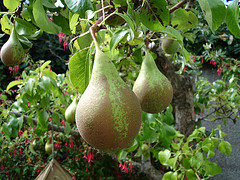 |
| Freshness facts | |
| Optimum carrying temperature | -1,0°C to -0,5°C |
| Highest freezing point | -1,5°C |
| Acceptable product temp. at loading into containers | Max. 2°C above carrying temperature |
| Optimum humidity | 90% to 95% |
| Ventilation setting for containers | 10 m³/hr |
| Storage life | 1-3 months Bartlett (William's Bon Chrétien) 3 months Beurre Bosc 3-4 months Comice 3-6 months Packham's Triumph 4-6 month d'Anjou |
| Climacteric / non-climacteric | Climacteric |
| Ethylene production | High |
| Ethylene sensitivity | High |
| Modified / controlled atmosphere | 0-3% CO2; 1%-3% O2 |
| Potential benefits | Excellent |
| Availability | |
| Europw Australia New Zealand South Africa South America |
July - June (year round) February - July February - July February - July January - June |
Pears
Contents
Harvesting and Handling
The pear is a fruit that has expanded all over the world. It is consumed both fresh as cooked and is available all year round.
A large number of varieties are cultivated, ranging in shape, size and colour.
Harvesting at the correct time is essential to ensure maximum storage life. Pear fruit harvested with improper maturity are more susceptible to physiological disorders and have a shorter storage-life. Immature pears are more susceptible to superficial scald, shrivelling and friction discoloration while over mature fruit tend to have higher incidence of core breakdown and CO2 injury.
One of the most satisfactory and easiest ways of determining proper harvest maturity is to measure fruit firmness. Pressure tests using a penetrometer on the pared surface gives an indication of flesh firmness. Firmness decreases with maturation. Different varieties have different firmness at maturity. The pressure can be read in kilogram force (kgf). At the pre-climacteric stage, the firmness of most pears varieties is between 9 and 10 kgf. During ripening, the firmness decreases by approx. 2-3 kgf. Pears testing at <5 kgf will have little storage life remaining and should be sold at earliest convenience.
The fruit must be handled very carefully, since during harvest and handling bruising can easily occur and may start to rot within just a few days. Where possible, the pears should be of uniform size and packed in pre-formed mouldings to even out pressure and prevent injury. Size grading is generally performed mechanically. Packaging in (export cartons and) polyethylene bags has beneficial effects on storage and shelf life, but retards cooling.
Quality characteristics and criteria of a properly ripened pear fruit are buttery and juicy texture with the distinct pear aroma and taste of each pear cultivar.
Grades include Extra Fancy, Fancy and Unclassified (or Third Grade), primarily based on external appearance.
Cooling and Storage
Pears are very sensitive to temperature. The storage-life of ‘d’Anjou’ and ‘Bartlett’ pears has been reported to be 35 to 40% longer at -1 °C than at 0 °C. Most pears are stored at -1 °C with RH of 90 to 95%. Many operators of pear storage rooms use thermocouples in the air and in fruit to determine temperatures at selected areas in the storage. Precise temperature control is needed to prevent freezing when pears are stored at these low temperatures. Rapid removal of field heat and prompt cooling of harvested pears are essential for long-term storage. During the pull-down period, room temperatures of -3.5 °C to -2.0 °C can be used but should be raised to -1 °C as the fruit temperatures approach this temperature.
Pears are moderately susceptible to freeze damage. Once the pears are pre-cooled properly at 0°C / -1°C, temperatures of lower than -1°C should be avoided. Pears with low sugar content are more vulnerable for low temperatures. After slight freezing, the skin as well as the fruit flesh may show a dark glassy appearance. If subjected for a longer time to low freezing temperatures, the fruit flesh may turn brown. Pears may recover from initial freezing injury with dark glassy tissue once the pears are exposed to slightly elevated temperatures above the freezing point.
After subsequent storage, cavities may develop in the injured tissue. Affected pears fail to ripen. Even in the absence of obvious symptoms, fruits which have been exposed to freezing temperatures are weakened and their storage life is curtailed.
Susceptibility to freezing injury is determined not only by the degree and duration of freezing conditions but also by the physiological state of the fruit.
Fruits may suffer freezing injury whilst on the tree, in store or during transit. Exposure to freezing conditions tends to be more damaging to harvested fruits than those still on the tree.
During transportation in reefer containers, the ventilation setting should be low, between 0-15 m3/h. If the pears are carried at a temperature of around 0°C/-1°C, the respiration is very low and there is no risk of injuries due to low O2 or high CO2 levels. At temperatures of around 0°C and a (slightly) opened fresh air supply, entering humid air may will cause ice deposit and frequent defrosting, what can be a burden on the cooling capacity of the reefer container, resulting to slightly elevated transit temperatures once carried in warm regions.
Delay in cooling shortens storage-life. It has been suggested that the core temperature should be reduced to near the holding temperature in 4 days. When pears are packed in cartons before cooling, cartons should be stacked to provide exposure of the sides to airflow. Pears loose moisture rapidly; hence, it is advisable to hold the RH > 90%. Polyethylene liners are effective in controlling moisture loss. Intermediate temperatures of 2.5°C to 10 °C are harmful to some pear cultivars. ‘Bartlett’ pears stored at this temperature have dry texture and inferior flavour.
Winter pear varieties can be stored in CA at -1°C for up to 4 months (Bosc & Comice) or 6 months (Anjou) while maintaining their capacity to ripen and attain good flavour and texture. Summer pears, including William's Bon Chrétien and Comice, are extremely sensitive to high temperatures, and special effort should be made to maintain the cold-chain.
Pears can be stored under CA (Controlled Atmosphere) at 0%-3% O2 and 1%-3% CO2.
Pears have a long PSL (potential storage life) of between 3 and 6 month, depending of the variety and therefore CA is not used often during transportation, but only for long time storage in cold stores.
Mixed loads
Pears generate ethylene and so should not be shipped with ethylene-sensitive commodities such as kiwifruit and persimmons.
Cautions
CO2 levels above 3% are injurious and may cause cavitation, brown core, surface pitting, core cracking or flesh discoloration. O2 levels below 1% may cause brown core, black skin spots or alcoholic off-flavours.
Storage disorders
Alcohol formation, Alternaria rot, Aspergillus rot, Bitter pit, Black rot, Blue mould, Botryodiplodia rot, Breakdown, Brown heart, Brown rot, Brown spot, Bruising, Bulls eye rot, Carbon dioxide injury, Cladosporium rot, Deep scald, Freezing injury, Fusarium, Grey mould rot, Mucor rot, Phytophthora, Pink mould rot, Powdery mildew, Rhizopus rot, Ribbon scald, Russeting, Scab, Sclerotium rot, Soft scald, Sooty blotch, Superficial scald, Water core, White rot.